
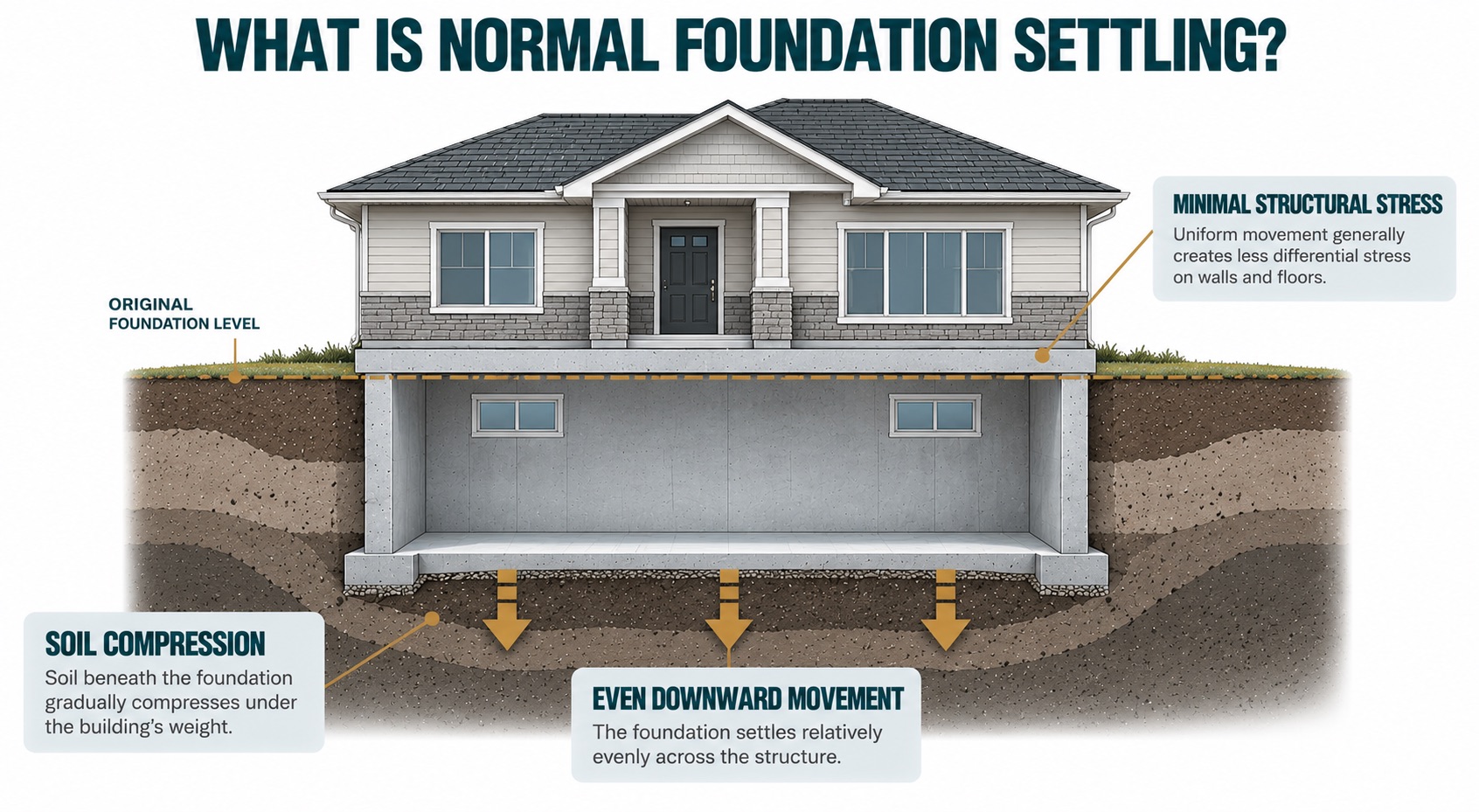
Yes, some foundation settling is normal. As a house ages, the soil beneath its foundation can compress and shift under the building’s weight. Minor, even settlement is generally expected, especially during the first few years after construction. However, excessive or uneven settling can lead to foundation cracks, structural damage, and other problems that require attention.
For homeowners in Edmonton, understanding the difference between normal settling and potentially serious foundation movement can help prevent expensive repairs.
What Causes a House Foundation to Settle?
Foundation settling happens when the soil supporting a home compresses, shifts, or loses its ability to support the building evenly.
Several factors can contribute to foundation movement:
- Soil compression: The weight of a house gradually compresses the ground beneath its foundation.
- Moisture changes: Clay-rich soils can shrink during dry conditions and swell when they absorb water.
- Poor drainage: Water collecting around a foundation can weaken supporting soils or contribute to soil movement.
- Freeze-thaw cycles: Alberta’s changing temperatures can cause frost-related ground movement, particularly where soil moisture and frost conditions allow it.
- Soil erosion: Leaking underground pipes or uncontrolled drainage can erode the soil.
These conditions don’t always cause structural damage. Problems are more likely when movement is excessive, uneven, or continues over time.
How Much Foundation Settling Is Normal?
There is no single measurement that determines how much foundation settling is acceptable for every home. The amount of movement a foundation can tolerate depends on its construction, soil conditions, and whether the settlement occurs evenly.
A house that settles slightly and uniformly may experience little noticeable damage. However, when one section of the foundation sinks more than another, the resulting stress can cause cracking and structural movement.
This is known as differential settlement.
The National Research Council of Canada reports that differential ground movement can exceed 51 mm in a single year under certain conditions involving moisture-sensitive soils, including the effects of nearby trees.
This figure illustrates how significant soil movement can become. It is not a normal settlement allowance or a threshold for determining whether a foundation is safe.
What Are the Warning Signs of Foundation Settling?
Foundation problems don’t always begin with large, visible cracks. Sometimes, the first signs appear elsewhere in the home.
Common warning signs include:
- Diagonal or stair-step cracks: Cracks developing through foundation walls, masonry, or interior finishes.
- Doors and windows that stick: Frames becoming misaligned as parts of the building shift.
- Uneven or sloping floors: Noticeable changes in floor levels that may indicate movement beneath the structure.
- Gaps around walls and ceilings: Separation appearing where building materials previously met.
- Growing foundation cracks: Existing cracks are widening, lengthening, or showing displacement.
Not every crack or sticking door indicates foundation settlement. Concrete shrinkage, humidity, and other building movements can produce similar symptoms.
However, multiple warning signs appearing together, especially if they are worsening, warrant professional evaluation.
Can Foundation Settling Be Repaired?
Yes. Many foundation settlement problems can be repaired or stabilized, although the appropriate solution depends on the cause and extent of the movement.
For example, poor drainage may need to be corrected to prevent further soil instability. If a foundation has experienced significant structural settlement, underpinning or another engineered stabilization method may be necessary.
Foundation cracks may also require repair to restore water resistance or address structural damage.
It’s important to identify the underlying cause before repairing visible cracks. Sealing a crack without addressing ongoing foundation movement may allow the problem to return.
When Should You Be Concerned About Foundation Settling?
Minor, stable settlement is not necessarily a reason for concern. However, new structural cracks, noticeable changes in floor levels, or movement that continues over time should not be ignored.
If you notice changes around your home, photograph the affected areas and record when they appeared. This information can help a foundation specialist determine whether the problem is progressing.
For homeowners in Edmonton, seasonal moisture changes and local soil conditions can complicate foundation movement. A professional assessment can help distinguish ordinary building movement from problems that require structural repairs.
Concerned About Your Foundation? Contact CrackPros
If you’ve noticed new foundation cracks or signs of uneven settling, CrackPros can help you investigate the problem and understand your repair options.
Our Edmonton-based foundation repair team specializes in foundation crack repair, structural concrete repair, and solutions for damaged foundations.
Contact CrackPros to discuss your foundation concerns and find out what repairs may be needed.
Does a house ever stop settling?
Most initial settlement occurs after construction, but some soils can continue compressing over many years. Seasonal moisture changes can also cause ongoing ground movement.
Can an older house suddenly start settling?
Yes. Changes in drainage, soil moisture, underground plumbing, or nearby construction can contribute to new foundation movement, even in homes that have been stable for decades.
Do foundation cracks always mean a house is settling?
No. Foundation cracks can result from concrete shrinkage, temperature changes, hydrostatic pressure, or structural movement. The crack’s location, pattern, and progression help determine its likely cause.